Thursday, May 20, 2010

Dry Fork Loop

Distance:  8.5 miles
Altitude Gained: 1290 ft.
High Point:  8680 ft.


yes, it makes a sound
when they fall and we're not there
trees are not alone


The Dry Fork Loop is an easy half day hike that joins up with a stretch of the Colorado Trail.  Pixler and Peel have rated it as moderate, but we beg to differ.  As a hike, it is so easy that it almost gets boring toward the end.  It is quite long and the climb and descent are extremely gradual, even though we went up via Hoffhein's Connection, the allegedly "much steeper" way.  We imagine that it is a fantastic bike ride as the traffic on the trail would suggest.  We like a hike with a little more push, but this one's nice if you are looking to just take an arborary stroll. 


We are always happy to pass an afternoon with the trees.  We saw a diverse array of Colorado beauties:  aspens, spruce, doug firs, a myriad of budding decidious and of course our good friends, the ponderosas.  There is just something about these pines.  They are engaged in some sort of cosmic dance that is blowing our mind.  The ones on the Dry Fork trail seem to be even older and wiser than others we have seen. 


They also seem to be more active so to speak.  Some dance, others do yoga.   And for some reason, this trail has an unusally high occurence of displaced trees.  A fallen tree traverses the path every so often.  Some of them look to have simply fallen over and others appear to have been ripped from the ground by an angry giant. 


Ironically, the forces that bring these beasts down are of the microscopic variety.  These majestic beings can fall victim to a number of destructive little terrorists: parasitic plants like the Dwarf mistletoe (Arceuthobium americanum), deadly root-fungi or Black stain root disease (Ophiostoma wageneri), and of course the hundreds of insect species that attack the ponderosa, most devestating are those in the Ips and Dendroctonus genuses; the beetles.
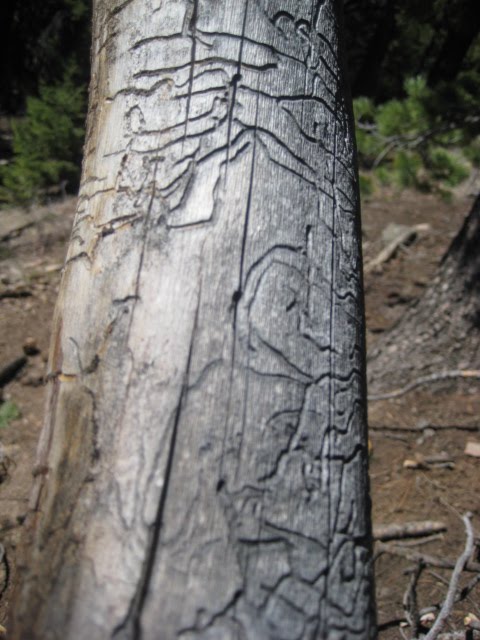

tunnels or galleries left in the underbark of a Ponderosa
by adults and larve of Dendroctonus ponderosea.


The Aspens are a major presence in these parts too.  Last year's leaves make a patchwork quilt across much of the trail.


But seriously, what causes a tree to grow like this? At what point in its 300-600 year lifetime does the ponderosa pine start vogueing?  Do they just get bored some decades and decide to stretch their branches in a new direction?  Seriously, if any can explain this to us...

What characters! 


This photogenic Green Comma (Polygonia faunus) butterfly danced with us a moment before graciously posing for this glamour shot.  These brush-footed butterflies are easy to identify because of their ragged wing edge and the thick dark borders with little yellow spots.  Their flickering bursts of color make the forest feel a little more enchanted.


From out of nowhere, this mysterious game bird scurried across the ground and fluttered up into a pine tree to hide.  It looked a bit like a chicken and had a strange tessalated pattern on its underbelly and hindwings and a distinct crest on its tiny head.  Our most educated estimation is that it is a Scaled Quail (Callipepla squamata), definitely not an ave that we expected to see.


As suggested by Pixler and Peel, we took a short detour east down the Colorado Trail to Gudy's Rest, a scenic stop memorializing Gudy Gaskill, one of the pioneers of the trail.  It is a nice resting point, and it gets a hiker to thinking about the sheer marvel of the Colorado Trail, a 475 mile footpath from Durango to Denver.  The trail is including in Hiking Trails, and although we don't anticipate getting to it this season, it is on our list of things to do (and blog about). 


Wednesday, May 5, 2010

Log Chutes Trail

Distance:  small loop 4.7 miles (plus 3.6 round trip from car to trailhead)
Altitude Gained:  880 ft (plus some)


it occurs to us
that the ponderosa pines
have reached nirvana


Now this is our kind of trail:  enchanted friendly forest of old wise ponderosa pines highlighted by the occasional aspen grove.  As the name of the trail suggests, some of these pines are destined to be logs for human use.  But we imagine that when their time comes, they take their death with honor.  They seem to have reached a state of consciousness that our human brains cannot understand.  Some appear to be engaged in yoga or a very slow interpretative dance.


Let it be known that we could not drive all the way in to the parking area for the trail as Junction Creek Road was closed several miles beforehand.  We aren't sure why, perhaps because the campground isn't open yet?  


It made for a nice walk anyway, but because of the extra time, we were unable to do the big Log Chutes loop.  Nevertheless, we got into the woods, which is what we were looking for.  Of the "city hikes" we have been doing thus far, the Log Chutes trail feels the farthest removed from town.  You get the occasional view of the valley and the Fort, but it still feels like you are in the wilderness.


This Aspen ( Populus tremuloides)  grove struck our eye; we loved the contrast of their bare white bodies amongst the jolly green giants.  Aspen trees are incredible!  They are disputably, the largest living organisms on earth.  All Aspens standing together in a grove are connected by an underground root system derived from a single seedling; hundreds of trees all genetically identical...amazing!

We also saw small living organisms, like this Short-horned Lizard (Phrynosoma hernandesi).   


And in our tradition of scat identification, we present the droppings of a Bobcat (Lynx rufus), the most common wildcat species in Colorado.  Their scat is long and cylindrical, containing hair and bones.


(Here's your drama Will:  see how Kristin fords this river with the acumen of a crouching tiger!  Okay, we'll do better next time...)


There was an abundance of running water making music on our hike, reminding us that the snow is melting rapidly.  Soon we will be able to get higher!


Thursday, April 22, 2010

Meadow Loop/Telegraph Trail

Distance: 5 miles
Altitude Gained:  880 ft
High Point:  7480 ft


welcome to life
flora, and our gratitude
for painting the day

The Meadow Loop and the Telegraph Trail are two more trail options in the extensive Telegraph system.  John Peel lumped them together in the 4th edition as a suggested hike of their own; we dig.  It's high point is near the top of the next ridge over when you look east from Raider.  You have endless options when you hike around in these trails, but we find this suggestion a good route for discovery when you only have a few hours but you want to climb a little to great views. 


We had a glorous hike.  The spring is coming alive, and so are we.  We absolutely love this planet we're on.  Happy Earth Day!


We think Maggie and Barb Casey feel the same way.  They were on mountain bikes of course, as was every other person we passed on trail.  This athleticism impresses us, naturally.  But we are happy to be hikers.  Hiking, one sees and contemplates more of the treasures the trail has to offer.


up on telegraph
dead trees tell ancient secrets
of Earth's yesterday


These dead trees left standing in the forest to decay naturally are called snags, and we love em'.  We are impressed not only with their astounding aesthetic but also because these seemingly lifeless trees support hundreds of different species in the forest ecosystem!  Mammals, birds, reptiles and insects shack-up together in the beautiful hardwood condos.  Plus, the dead wood attracts mosses, fungi and lichens which serve as food to these tenants while they aid in decomposition, returning vital nutrients to the soil. Ahhhh, the cycle of life!
Our botanical friends are alive and blooming; the smell of Mountain Sagebrush tickled our nose, new Apricot blossoms are everywhere and the Scarlet (or Indian) Paintbrush threw us bursts of vibrant red.  


 We saw some more scat, same as before but older: very hairy, curly-like, tapered ends.  This is the second time in Horse Gulch that we have seen evidence of our feline friend, the Mountain Lion.  Because pumas are incredibly solitary and territorial, we believe we are "tracking" the same cat; the home range of a male is 30-100 square miles and excludes other male mountain lions.  In that case, we feel we're forming a small bond :)  What shall we name him?
    

Our highlight this hike: the Western Chorus Frog (Pseudacris triseriata)
We think this symphony says it all...


Sunday, April 18, 2010

Raider Ridge

Distance:  4.6 miles
Altitude Gained:  880 ft.
High Point:  7480 ft.


north, south, east, and west
circumspectacular views
of where we're livin'


Raider Ridge is our neighborhood mountain; the trailhead is 9 blocks from our house.  As FLC alumni, it holds a special place in our hearts as our campus basically sits in its lap.  It affords some of the best views of our perfect little river valley home.  As you walk along the top of the ridge (also a hogsback, geologically speaking), the perspective changes, revealing how the Animas River left its print in the Earth's surface.  Contrary to popular misconception, the Fort Lewis campus is not a mesa, but a river terrace.  According to Encyclopedia Brittanica, a river terrace is a "bench or step that extends along the side of a valley and represents a former level of the valley floor."  
  

Raider Ridge is part of the Telegraph Trail system, a gigantic series of lovely trails east of downtown, which from what we can tell, must be mountain bike heaven.  We enjoy them plenty on our two feet.  At last publication of Hiking Trails, there was no trail connecting back from the north end of the ridge; to get down from the "extended ridge" you had to turn around and go back or bushwhack back down to Horse Gulch.  But thanks to a compromise in 2009 between the city, Trails 2000, and property owner and lifetime Durangoan Jake Dalla, you can now make a full loop. (more) 


The main trailhead is located on 9th Ave. and East 3rd St.   Although technically prohibited, many FLC students charge up the side of it.  It is difficult not to do so as the ridge feels as if were part of the campus.  The mountain is named for the college's former mascot, the "Raiders" (Pixler notes that at one time the students maintained a giant "R" on the side of it).  We stumbled upon some FLC students who couldn't resist the temptation to raid the ridge; we found them sunning themselves on the black dirt like lizards. 


Near the south end, Raider Ridge features a sort of sandstone living room, a collaborative effort between nature and man.  You can rest your bones after the climb in a number of different chairs and loveseats.  We took a moment to consult Pixler and Peel.


The critters in Horse Gulch are dewinterizing in the warm April sun; we were lucky enough to spot many plateau lizards, dance with a California Tortoiseshell, hear the threatening rattle of a pit viper, and track a deadly mountain lion!  


The reptiles joined the students out in the sun for some solar heating. The lizards were darting here-and-there under the brush throughout the whole hike.  We got two pictures of the lil' Sagebrush lizard (Sceloporus graciosus), who is surprisingly photogenic. 


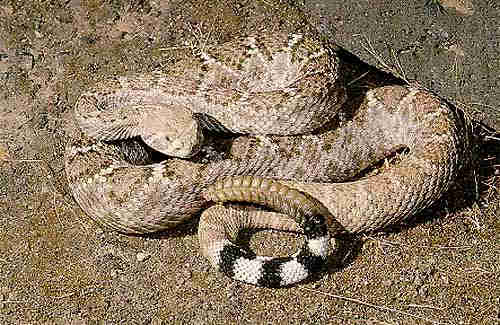
On our descent, as we joyously bounded down the ridge, we were stopped abruptly in our tracks by the sound of a rattlesnake.  Using our better judgement, we didn't stop for a picture.  However, I can deduce that the ominous rattle came from the Western Rattlesnake (Crotalus viridis) because it is one of only two rattlers found in Colorado; the Massasauga is limited to the eastern grassy plains and the Western is found virtually everywhere in the state.  These guys have been hibernating all winter in their snake dens and they sun themselves for several days after waking.  Needless to say, these snakes are hungry and easily agitated after a long winter...no wonder we got a warning rattle!  (photo source: http://www.venomousreptiles.org/)


Ironically,the species highlight of Raider Ridge was not seen, and we were very grateful for the non-sighting! First, we came across some very hairy scat, which clearly belonged to a cat because of the tapered ends. Then, about 20 feet down the trail we stumbled upon some large prints in the mud matching those of a mountain lion (Puma concolor):  round, lobed heel pad, toes evenly spread, and lacking claw marks.  This is prime real estate for a mountain lion, as they prefer to stalk their prey from trees and high cliffs. These predators are primarily nocturnal and entirely carniverous, preying on hares, raccoons, skunks and deer.  They are excellent climbers, extraordinary leapers and will even swim if necessary!    


As we left, a beautiful butterfly flittered and fluttered around our heads until we stopped to let it land at our feet.  Unfortunately, our camera's battery had already died and we were unable to get a picture.  But we were able to get a great look at this beauty, and we are nearly positive that it was a California Tortoiseshell (Nymphalis californica) or another close relative.  Its piano-key wings were distinct and memorable.  We borrowed this photo from the Internet.   

c. John Sterling (source: http://www.cal.net/)


We adore and HIGHLY recommend Raider Ridge.  It is good for a quickish hike or a longer, more leisurely one.  A breathtaking place to spend time.  We'll be back in the area soon to check out more of the Telegraph system and to keep on tracking our puma :).  


Friday, April 9, 2010

Animas (City) Mountain: Part 1

Distance: this time, just a fraction, maybe a mile?
Altitude Gained: 900 ft?  1000ft?


O bluebird! O spring!
O friendly city mountain!
O my soul's own peace! 


Today's hike was just a preview of Animas as the majority of the mountain is still closed to human traffic.  But after Hogsback we needed something a little friendlier.  And we love this mountain, always have. 


Animas Mountain or Animas City Mountain?  Which is the true name of Durango's most beloved mountain?  Why can't it just be both?  John Peel himself wrote an article recently about this very topic.  We tend to just call it Animas, actually.  "It's a beautiful day.  Let's go hike up Animas!" 

The main trailhead is at 32nd and W. 4th Ave, but we like to catch an alternate trail through some private property before the water tower.  The second we got on the trail today, it was like we were home. 


There is something about the energy on this trail that soothes the soul.  It is as calming as it is invigorating.  We are always saying that Animas Mountain is the friendliest mountain around.  It just sort of takes you by the hand, you know.  You can leave your troubles back in the city, and Animas will always help you remember what life is really about.


It didn't hurt that it was sixtysomething degrees outside.Or that the birds were engaged in a full-on spring symphony.  I guess you could say it what one of those Zip-A-Dee-Doo-Dah days.  And although the bluebird didn't land directly on our shoulders, it may as well have for all the wonderful feelings comin' our way. 

The mountain bluebirds (Sialia currucoides) were too busy enjoying the spring day to even notice us.  The pair we watched was busy building a nest to house their new babies that will be coming soon. Actually these birds prefer to nest in pre-existing cavities or man-made nest boxes; usually the female builds up the nest and the male pretends to help.


We didn't see any of the majestic elk (cervus elaphus) for whom the mountain is closed, but they had been around recently.  The BLM closes Animas Mountain some years to create a safe winter habitat for elk and deer when the climes of the higher altitudes get too extreme (more).  The elk are an interesting bunch.  According to the field guide, they are "gregarious animals."  Apparently, no other mammal male gets more action than the elk bull; one bull will mate with the entire harem of cows.  Maybe they should seek habitat in Utah?

The rising temperatures are surely sending the elk back into higher country, leaving Animas Mountain for we humans to enjoy for the summer.  The rest of the trail opens in a week; stay tuned for the completion of this lovely mountain!


enchanted forest!